
BHFF Senior Fellow Scholar Imad Buljić and Delaida Muminović Present AI Research at Kiss the Future AI Summit
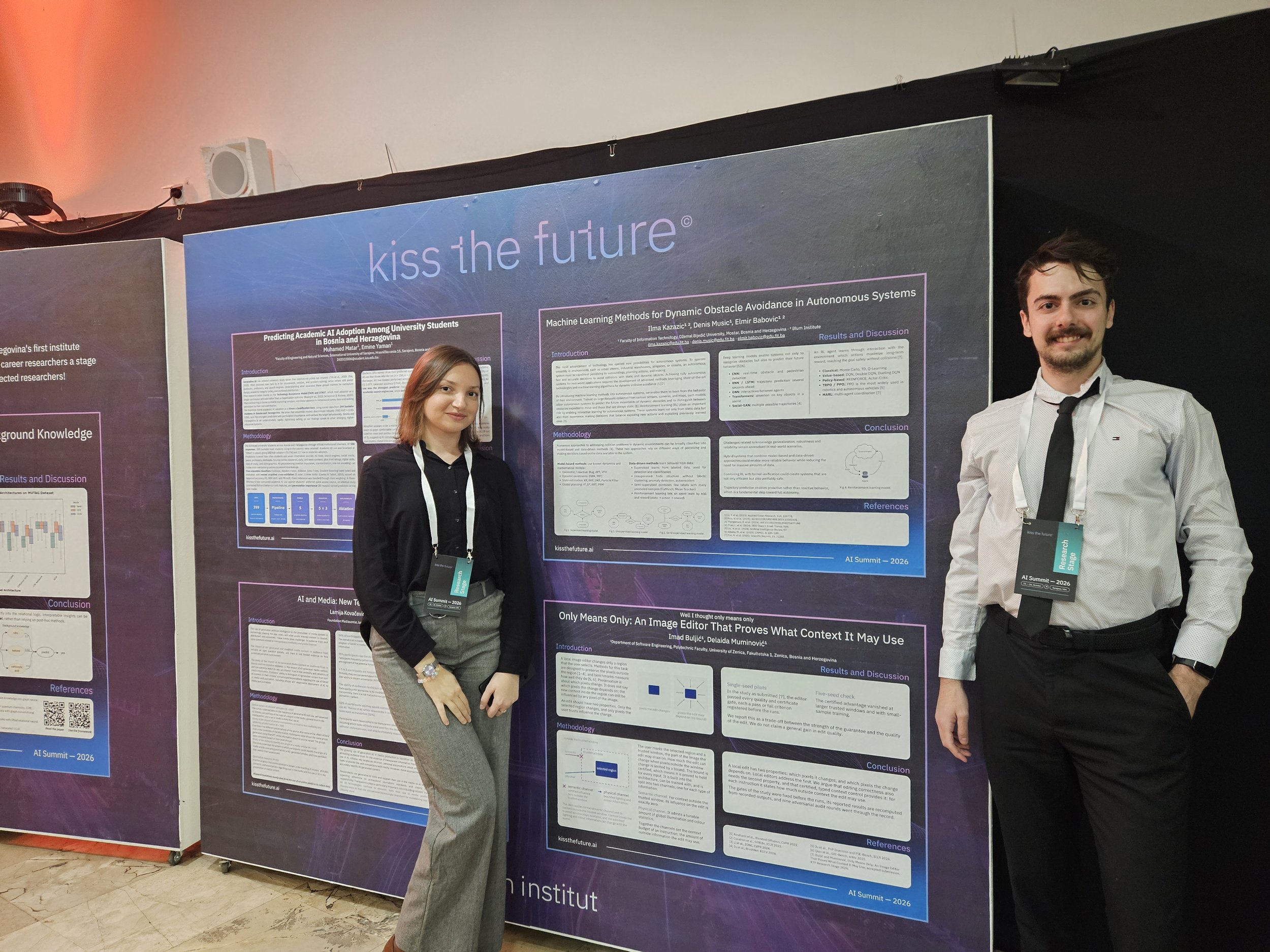
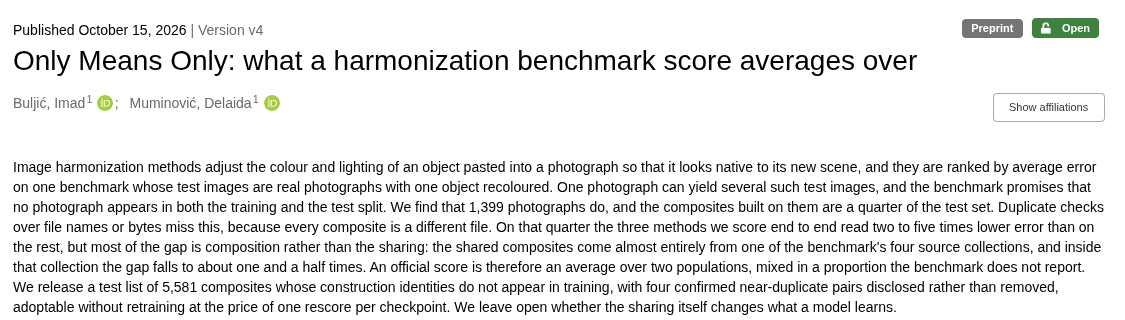
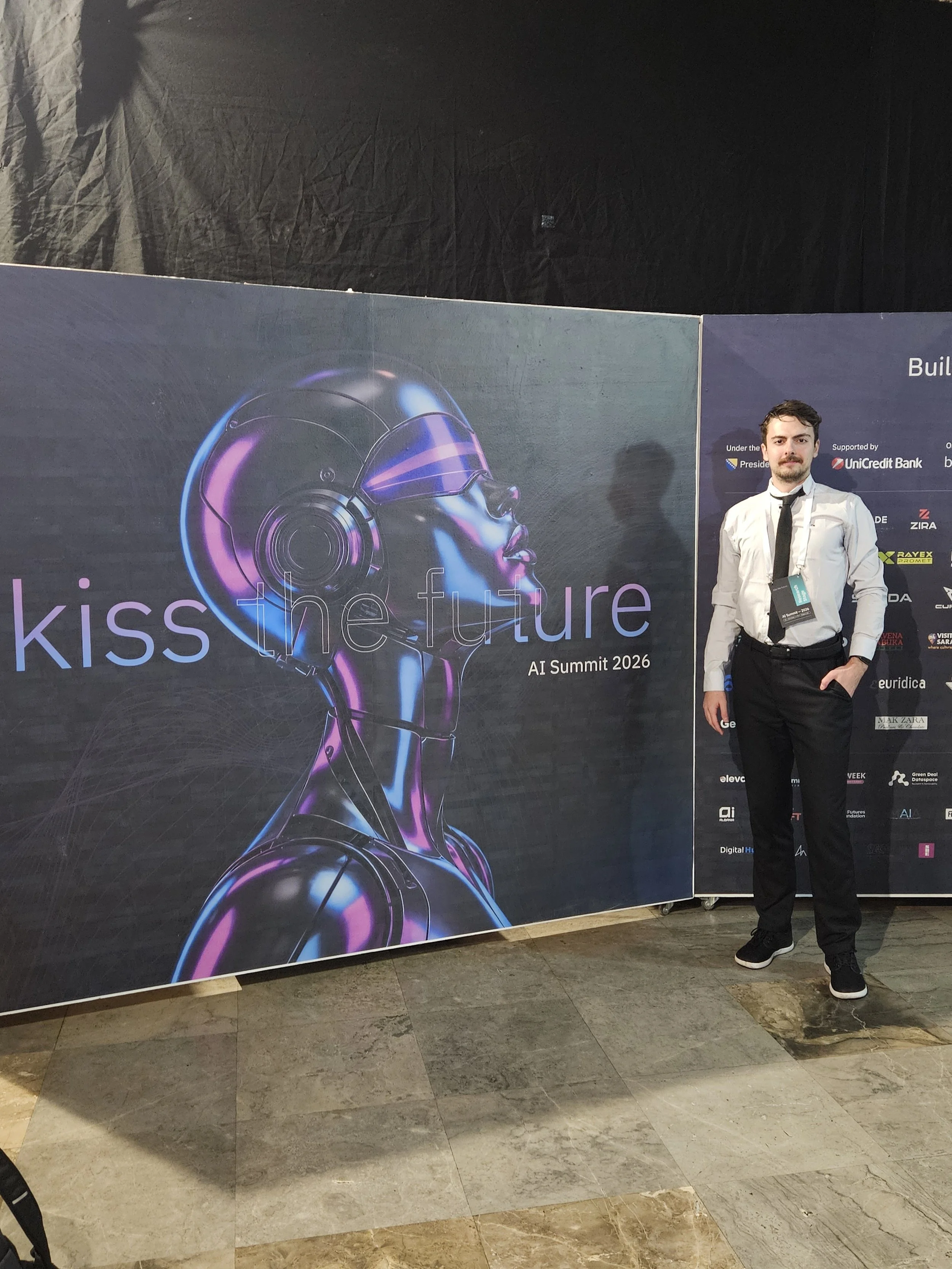
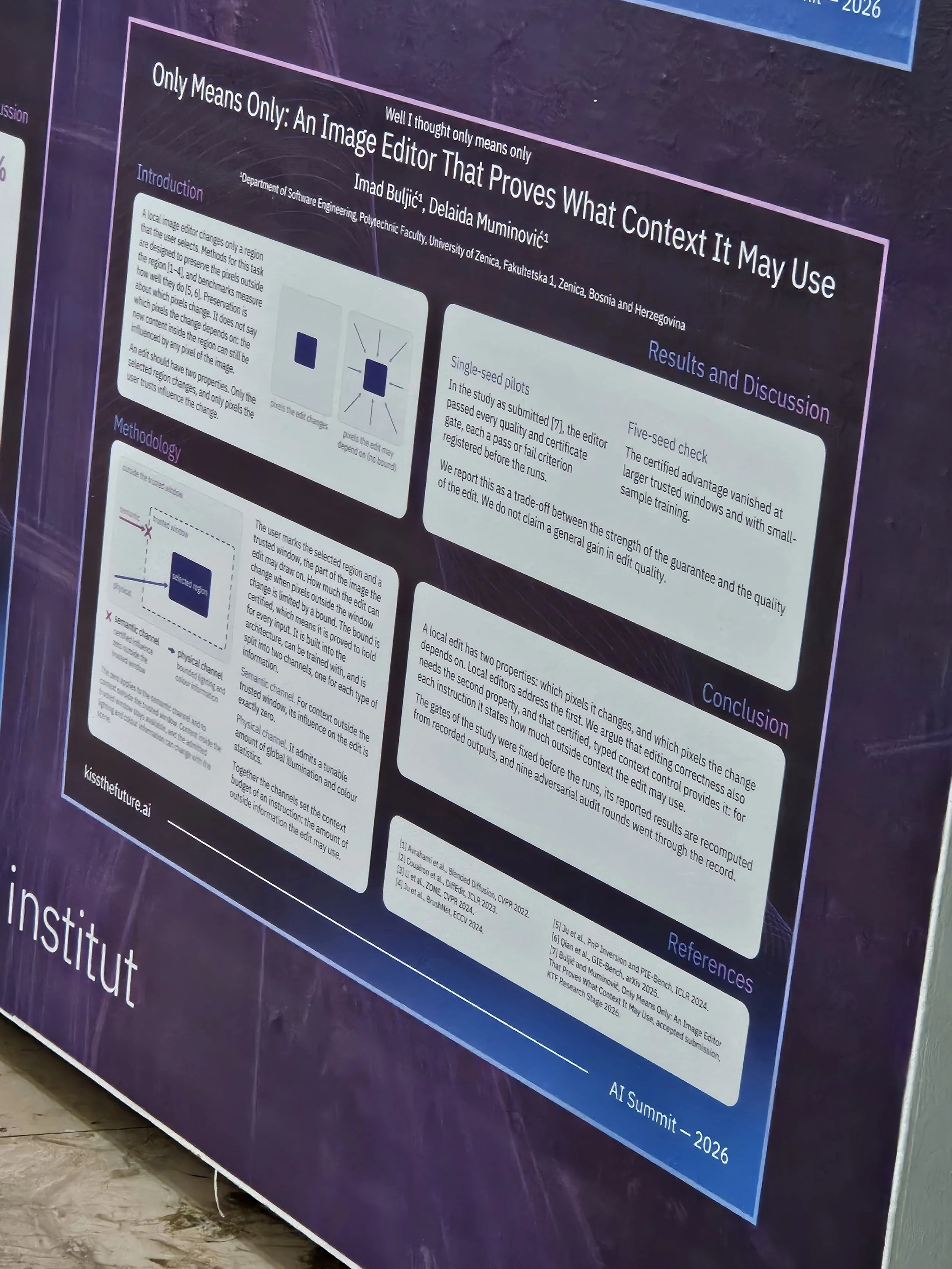
BHFF Senior Fellow Scholar and Innovation Nation 2026 Fellows, Imad Buljić and Delaida Muminović presented their research at the second Kiss the Future AI Summit, held on October 16, 2026, in Sarajevo. Their work, titled “Only Means Only: What a Harmonization Benchmark Score Averages Over”, was showcased as a research poster at the summit's Research Stage.
Organized by Blum Institute and Bloomteq, the summit brought together researchers, engineers, and technology professionals to explore the latest developments in artificial intelligence and its applications across industries.
For Imad and Delaida, the event was an opportunity to share their findings with the wider AI community and contribute to an important discussion about how artificial intelligence models are evaluated.
Questioning How We Evaluate AI Models
Their research focuses on image harmonization, a field of computer vision in which AI models adjust objects inserted into photographs to make them appear naturally integrated into the original scene. This involves matching lighting, colors, and other visual characteristics.
However, Imad and Delaida investigated an important question: What happens when the original photographs used to evaluate these models have already appeared in their training data?
Their analysis of iHarmony4, one of the most widely used benchmarks for image harmonization, identified 1,399 original photographs appearing in both the training and testing portions of the dataset.
Examples derived from these photographs account for almost a quarter of the test set, despite the expectation that training and testing data should remain independent.
When evaluating three different methods, the researchers found that errors on this overlapping portion of the dataset were two to five times lower than on the remaining examples.
Importantly, their findings suggest that much of this difference can be explained by how the dataset was constructed, rather than necessarily indicating that the models had memorized the photographs.
This distinction matters because benchmark scores are widely used to compare AI models and assess their performance.
Contributing to More Reliable AI Research
Beyond identifying the issue, Imad and Delaida developed a practical resource for the research community.
They published a revised evaluation list containing 5,581 examples, allowing other researchers to reassess their image harmonization models without having to retrain them.
Their work also included the development of a smaller neural network for image harmonization, featuring separate physical and semantic channels and a mathematically proven bound on contextual influence.
Used as an additional control method, the network achieved results comparable to the established DoveNet model.
Although this architecture was not the primary contribution of their research, the team sees potential for further development and possibly a separate scientific publication.
Research Driven by Curiosity and Determination
A particularly notable aspect of their research journey is that much of the experimental work was conducted using their own computing equipment.
The researchers relied on a self-funded PC specifically equipped for research purposes, alongside their personal laptops, which allowed them to run experiments in parallel.
As they prepare to expand their work, access to more powerful computational resources will become increasingly important.
Imad and Delaida are therefore interested in potential collaborations with universities, research laboratories, and institutions that could provide additional GPU and CPU computing capacity.
Their research has already been made publicly available as a preprint on Zenodo and arXiv, together with code, verification materials, and other resources supporting the reproducibility of their findings.
From a Conference Poster to Future Scientific Contributions
Presenting their research at Kiss the Future AI Summit marks an important milestone, but the researchers see it as only the beginning.
They are currently preparing their work for submission to a scientific conference, with plans to expand their experimental evaluation and continue investigating how image harmonization models can be assessed more reliably.
Their broader ambition is to ensure that the findings and tools they have developed can benefit other researchers and contribute to improvements in AI evaluation practices.
As BHFF Senior Fellow Scholar and Innovation Nation 2026 Fellows, Imad and Delaida, demonstrate how curiosity, independent research, and a commitment to solving real-world challenges can lead to meaningful scientific contributions.
Their work reflects the spirit of the Bosnia & Herzegovina Futures Foundation: empowering young people to explore new ideas, challenge existing approaches, and contribute to scientific and technological progress.
Because building the future of artificial intelligence is not only about developing better models. It is also about asking better questions and ensuring that the methods used to evaluate them are reliable.