3 Minute Thesis Competition-Powered by UniCredit Bank: Science Beyond the Lab - Why Communication Is No Longer Optional
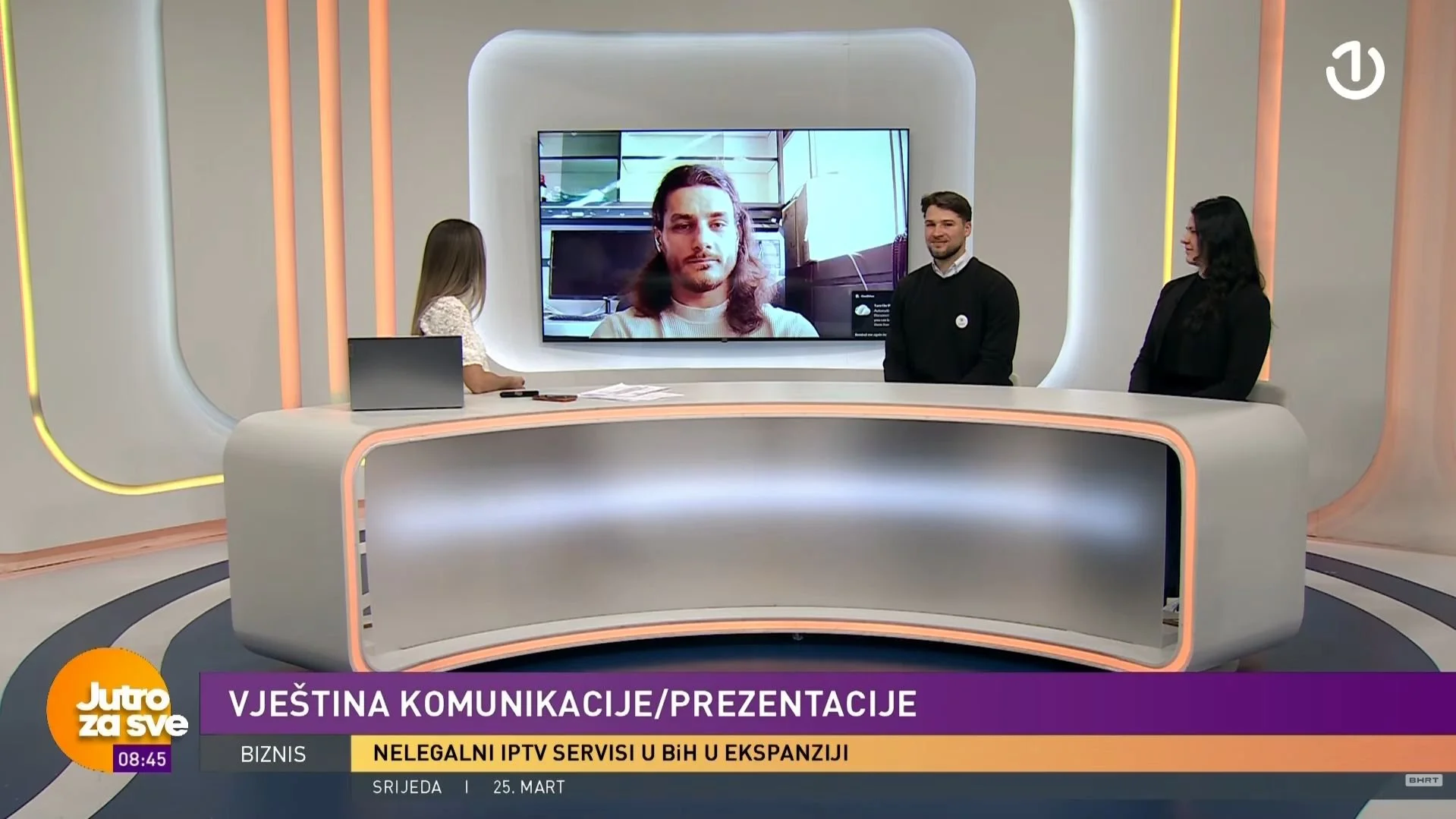
At a time when science and technology shape nearly every aspect of modern life, a paradox continues to persist: the more advanced science becomes, the less accessible it often feels to the people it is meant to serve. This issue was at the center of a recent episode of “Jutro za sve” on BHT1, where guests Kajs Hadžić, Ilma Hodžić, and Usame Čolaković opened an important conversation about how science is communicated.
What became clear during the discussion is that the problem is not a lack of scientific progress, but the way that progress is shared. Scientific work is, by nature, complex and highly specialized. It often requires years of focused effort to fully understand. Yet along that path, it can become detached from the broader public. Research findings remain within academic journals, circulate among experts, and are presented at conferences, but rarely reach people in a form that feels relevant or understandable.
This creates distance between science and society. When people cannot understand what scientists are doing, it becomes difficult for them to see why it matters. Without that connection, there is less curiosity, less trust, and less support. Science does not lose its value in this process, but it does lose its ability to influence.
Part of the issue lies within the academic system itself. In many educational environments across the Balkans, students are encouraged to demonstrate knowledge through complexity. The use of technical language and dense explanations is often seen as a sign of competence. This approach works within universities, where the audience shares the same background. However, it becomes a barrier the moment communication moves beyond that environment.
The transition into industry, entrepreneurship, or public engagement quickly reveals this gap. In these contexts, clarity becomes essential. Ideas need to be presented in a way that is direct, understandable, and relevant to different audiences. Many young researchers are not prepared for this shift, simply because communication skills are not given enough emphasis during their education.
During the broadcast, Hadžić, Hodžić, and Čolaković emphasized that communication should not be seen as an optional skill. It is a core part of being a scientist today. Conducting research and publishing results is only one side of the work. The other side involves explaining those results, connecting them to real-world problems, and making them accessible to people outside the field.
Initiatives such as the 3 Minute Thesis (3MT), Powered by UniCredit Bank competition, supported by the Bosnia and Herzegovina Futures Foundation, were highlighted as strong examples of how this gap can be addressed. The concept is simple but demanding. Participants must explain their research in just three minutes to a general audience. This forces them to focus on what truly matters and to communicate it clearly.
For many participants, this experience changes the way they think about their work. It shifts the focus from sounding knowledgeable to being understood. That shift is not always easy, but it is necessary if science is to have a broader impact.
The discussion also brought the topic to a personal level. A simple question was raised. Can the people closest to you understand what you do? If the answer is no, then the issue is not the complexity of the science itself, but the way it is being explained. The ability to translate complex ideas into clear language is what allows science to move beyond the lab and into everyday life.
There is often hesitation among researchers when it comes to public communication. Many are concerned about oversimplifying their work or being misunderstood. Others are simply more comfortable staying within the boundaries of their field. These concerns are understandable, but they come with a cost. When scientists do not communicate, the space is often filled by incomplete or inaccurate information.
The appearance on “Jutro za sve” served as a reminder that science has a responsibility beyond discovery. Its value lies in its ability to inform and improve lives. For that to happen, it must be shared in a way that people can understand.
The message from the conversation is clear. The future of science will depend not only on what is discovered, but also on how effectively those discoveries are communicated.